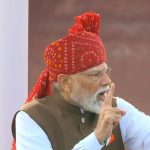
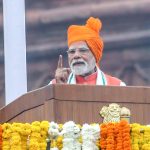
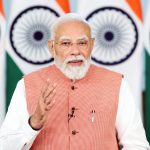
Prime Minister Narendra Modi on Saturday called for a faster pace of reforms, greater self-reliance and a renewed national effort to build a “Viksit Bharat” by 2047, unveiling a seven-point development framework centred on manufacturing, agriculture, technology, infrastructure, defence, the green and blue economy, and India’s soft power.
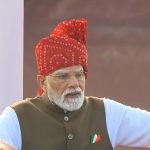
Addressing the nation from the ramparts of the Red Fort on the occasion of the 80th Independence Day, PM Modi said India could no longer afford “small dreams” and urged citizens to combine ambitious goals with firm resolve and greater national capabilities.
“Bharat has also set a very big dream today – a dream backed by firm resolve, a dream of reaching new heights. And that dream is this: when we complete 100 years of independence in 2047, we will have built a ‘Viksit Bharat’,” he said.
The Prime Minister said the goal would have to be achieved through the collective efforts of 140 crore citizens and asserted that the determination of the world’s most populous country to become a developed nation would change the way the world views India.
‘Vande Mataram’ echoes from Red Fort for first time since Independence
Beginning his address, PM Modi greeted the nation on the 80th Independence Day and paid tribute to freedom fighters, revolutionaries and Mahatma Gandhi.
“Today, every heartbeat resonates with the chant of Vande Mataram. Today, there is ‘Har Ghar Tiranga Hai, Har Man Tiranga Hai’,” he said.
He described the occasion as historic as “for the first time since independence, Vande Mataram is echoing from the Red Fort on August 15”, coinciding with the commemoration of 150 years of the national song.
PM Modi also expressed solidarity with people affected by floods and landslides in several parts of the country.
“I want to assure the affected families that we and the entire nation stand firmly with them,” he said.
‘We can no longer move forward with small dreams’
The Prime Minister said India’s development journey required larger ambitions, stronger resolutions and greater capabilities.
“We can no longer move forward with small dreams. We must dream big, because big dreams expand our thinking,” PM Modi said.
He said strong resolve enables a nation to overcome difficulties and challenges, while high ambitions raise the scale of its capabilities and efforts.
PM Modi highlighted India’s economic and social progress over the past 12 years, saying 25 crore people had moved out of poverty and the country had progressed from being counted among the “Fragile Five” to becoming a major and the fastest-growing major economy.
He said the achievements were the result of the collective efforts of people across social and geographical groups.
“Over the past 12 years, crores of citizens of the country… have made every possible effort to take the nation to new heights with determination and dedication,” he said.
Defence production up nearly four-fold, mobile manufacturing 35 times
Listing India’s progress, PM Modi said defence production had increased nearly four-fold, Khadi and Village Industries production nearly five-fold and electronics manufacturing nearly seven-fold over the past 12 years.
Production of modern railway coaches, he said, had increased 21 times and mobile phone production 35 times.
He also pointed to a nearly four-fold increase in internet users and patents granted, while digital transactions had increased 100 times.
The pace of providing tap-water connections, gas connections, toilets and houses to the poor had also increased substantially, he said.
PM Modi said thousands of compliances had been eliminated and hundreds of outdated laws repealed.
“The march of the 21st century cannot be carried out using the laws of the previous century,” he said.
‘Aatmanirbhar Bharat’ central to development strategy
The Prime Minister stressed that self-confidence and self-reliance were essential for India to become a developed country.
“Bharat should no longer live by depending on other countries. We must become self-reliant,” he said.
He said India was moving forward with Make in India, Swadeshi and Vocal for Local and argued that reliance on imported products, even when cheaper, did not build domestic capabilities.
India expanding semiconductor manufacturing
PM Modi cited semiconductors as an example of India’s drive towards technological self-reliance.
He said three major semiconductor plants had already started and that production had begun to be exported.
“Over the coming seven to eight years, another five, seven, or even eight semiconductor plants are expected to begin operations very soon,” he said.
He also highlighted the National Critical Minerals Mission and the government’s efforts to secure access to critical minerals, which he said were essential for the technology sector.
Nuclear power target of 100 GW by 2047
Energy security, PM Modi said, would be increasingly important as India expands AI, data centres, semiconductors and other energy-intensive technologies.
“Energy security is the need of the hour,” he said, highlighting nuclear power as a major component of the strategy.
He said the passage of the SHANTI Act had opened a new path and that India was working towards a target of 100 GW of nuclear power by 2047.
“Within this very decade, we have set a target of starting five new nuclear reactors,” he said.
PM Modi also said India had crossed an important milestone by mastering fast breeder nuclear technology, describing it as a major step towards self-reliance in nuclear fuel.
₹85,000 crore allocation for ‘Samudra Manthan’
The Prime Minister said India had historically restricted exploration of much of its coastal area, describing the approach as a “poverty of thought”.
He said 99% of India’s coastal area that had earlier been designated as a “No-Go Area” had now been opened for exploration.
“We have opened up that 99%, which was once designated as a No-Go Area, as a Go-Ahead Area, and we are now moving towards exploring the sea and discovering new reserves,” he said.
PM Modi said the government had recently decided to allocate ₹85,000 crore to accelerate the “Samudra Manthan” initiative.
Solar capacity rises from 2 GW to 160 GW
Highlighting India’s transition towards cleaner energy, PM Modi said piped gas infrastructure had expanded from 70 cities in 2014 to 700 cities.
The number of households covered by piped gas, he said, had risen from around 20-22 lakh to nearly 1.75 crore.
Solar energy capacity had also grown from just 2 GW before 2014 to 160 GW, he said.
He highlighted the progress under the PM Surya Ghar Muft Bijli Yojana, saying solar systems had been installed in 50 lakh homes.
“The electricity bills of thousands of households have become zero, while thousands of households are now earning by selling the surplus electricity they generate,” PM Modi said.
India completes railway electrification
PM Modi highlighted the rapid electrification of India’s railway network, saying only 30% of the network had been electrified in the 90 years after work began in 1925.
“We completed 100% of the work within this one decade. 30% in 90 years, 70% in 10 years – this is what work looks like,” he said.
He said railway electrification had reduced India’s dependence on imported diesel while also benefiting the environment.
PM Modi also highlighted India’s entry into hydrogen-powered rail transport.
“The country has started its first hydrogen-powered train, and I am pleased that it is the longest and most powerful train of its kind,” he said.
India needs to seize opportunities created by FTAs
The Prime Minister said India had entered into Free Trade Agreements with nearly 40 countries since 2014 and urged businesses, particularly MSMEs, to take advantage of expanded global market access.
“These trade agreements that have been made are a huge opportunity and hence I would especially like to tell my MSMEs that we should not miss this opportunity,” he said.
He called for Indian textiles, machinery, medicines, seafood and other products to reach global markets while meeting international standards on quality and cost.
“Our textile sector, spanning from Ludhiana in Punjab to Tiruppur in Tamil Nadu, has the potential to reach global markets,” he said.
He also pointed to the potential for Indian seafood exports, particularly shrimp, to expand through greater access to international markets.
‘Sapta Dhara’ to drive India’s next phase of development
The central theme of PM Modi’s address was the ‘Sapta Dhara’, or seven streams of national power, which he presented as the framework for India’s development over the next phase.
“The first power of Sapta Dhara is – manufacturing power,” he said.
The seven areas identified by the Prime Minister are:
1. Manufacturing power
2. Agriculture and food production
3. Technology and innovation
4. Gati Shakti
5. Raksha Shakti
6. Green economy and blue economy
7. India’s soft power
On manufacturing, PM Modi called for India to build complete value chains, from components to finished products and from design to manufacturing.
“India must emerge as a trusted hub in the global supply chain,” he said.
He identified cost, quality and scale as three key requirements and stressed the need for “zero-defect precision manufacturing”.
“Our mantra should be quality, quality, quality,” he said.
Farmers urged to move from farm to export market
Agriculture was identified as the second stream of Sapta Dhara.
PM Modi called for greater emphasis on food processing and exports, saying Indian farmers now had access to larger global markets through FTAs.
“We have to move from the farm to the export market,” he said.
He highlighted India’s traditional foods, millets, spices, fruits and flowers as products capable of becoming global brands and urged greater adoption of chemical-free farming.
‘Made-in-India 6G should reach every corner of the world’
Technology and innovation constituted the third pillar of the framework.
PM Modi said India must not merely become a market for global technology companies but should emerge as an innovation hub.
“Today is the age of AI, quantum technology, space, robotics and data centres. An entirely new domain has opened up,” he said.
He highlighted India’s experience with UPI and Digital Public Infrastructure and called for Indian digital technologies to be taken to the world.
“Bharat must lead in next-generation communication technologies. Our goal should be to ensure that Made-in-India 6G reaches every corner of the world,” he said.
Gati Shakti to focus on seamless connectivity
The fourth stream, Gati Shakti, would focus on faster and seamless connectivity through high-speed rail, highways, inland waterways, airports and multimodal logistics.
PM Modi called for a shift towards port-led development, saying ports should be seen not merely as locations for loading and unloading cargo but as engines of economic growth.
Defence self-reliance and next-generation technologies
Under the fifth stream, Raksha Shakti, PM Modi stressed the importance of self-reliance in defence.
“There is no alternative to being self-reliant in defence,” he said.
He called for India to develop next-generation defence technologies, drones, counter-drone systems and hypersonic defence capabilities and emerge as a global defence supplier.
He also highlighted cybersecurity as a growing area of national security where India’s youth could contribute.
Green and blue economy to create new jobs
The sixth stream will focus on the green and blue economy.
PM Modi called for India to achieve global scale in green hydrogen, renewable energy, energy storage, green mobility and green manufacturing.
He also highlighted the potential of India’s coastline for fisheries, coastal tourism and ocean technology.
“Bharat also has enormous opportunities in the blue economy,” he said.
Yoga, Ayurveda, culture and entertainment as India’s soft power
The seventh stream is India’s soft power.
PM Modi highlighted yoga, Ayurveda, faith, holistic healthcare, handicrafts, culture, films, VFX, animation, gaming and digital content as areas through which India could expand its global influence.
He called for the Heal in India initiative and the WAVES Summit to be used to showcase India’s capabilities.
The Prime Minister also highlighted India’s tourism potential, saying the country could attract more international visitors through its cultural and natural heritage.
“Why shouldn’t major global sporting events be held in Bharat?” he asked, also pointing to the growing concert economy and opportunities to build India as a global destination for entertainment.
PM Modi sets ambitious target for Indian companies
Calling for a stronger global presence for Indian businesses, PM Modi asked why 50 of the Fortune 500 companies could not be based in India within the next decade.
“Why shouldn’t an Indian bank’s flag fly among the world’s top banks? We should have an Indian bank among the world’s top five banks,” he said.
He similarly called for Indian pharmaceutical companies, consulting firms, accounting firms and technology companies to achieve global leadership.
“Our brands should become an identity of our country and make Bharat a destination for the world,” PM Modi said.
‘Reform Express’ to accelerate in coming years
PM Modi said India needed to change its work culture, thinking and pace of execution to achieve the 2047 goal.
“The work which has not been done in the last 5-7 decades, we have to do that work in the coming 5-7 years,” he said.
He described reforms not as a compulsion or a buzzword but as a matter of conviction.
“We have embarked on the ‘Reform Express’ and we are going to move towards next level reform in the coming days as well,” PM Modi said.
He called for the Centre, states, local governments, industry, producers and farmers to reform traditional systems and approaches.
One crore youth to be trained in AI skills
A major announcement in the address was the decision to train one crore young Indians in AI skills within the next year.
“We have decided that, in the next one year, we will train one crore young people in AI skills, so that the youth of our country have the capability to lead in the world of AI as well,” PM Modi said.
He also highlighted more than 2.5 lakh registered startups, the ₹1 lakh crore Innovation Fund, Skill India, the National Drone Policy, Khelo India and the opening up of India’s space sector.
Bioeconomy grows from ₹60,000 crore to ₹20 lakh crore
PM Modi highlighted the expansion of India’s bioeconomy, saying its turnover had risen from ₹60,000 crore before 2014 to ₹20 lakh crore.
He also said electric vehicle sales had increased from 1.5 lakh units in 2009-10 to 25 lakh units in 2025-26.
The aviation sector, Made-in-India aircraft production and drone-based applications were also highlighted as emerging areas of opportunity for young Indians.
Free online coaching for competitive examinations
Addressing concerns of middle-class families over the rising cost of coaching, PM Modi announced a programme to provide free online coaching for young people preparing for various examinations.
“The pressure of coaching classes has become a major burden for our middle-class families,” he said.
“We have the digital public infrastructure, we have excellent talent and we have teachers. By bringing these resources together, we are going to build an extensive network to provide free coaching to the young people of the country,” he added.
India steps up preparations for 2036 Olympics
PM Modi said India was moving towards becoming a strong contender to host the 2036 Olympic Games and highlighted the country’s preparations to host the Commonwealth Games in 2030.
He said India needed to expand participation in sporting disciplines in which it currently had little or no representation.
“We want the 2036 Olympics to be held in Bharat,” he said.
He announced a talent-hunt campaign across villages, cities and schools to identify children aged between five and 15 with sporting potential and provide them specialised training.
100-week campaign for ‘Nasha Mukt Bharat’
The Prime Minister also called for a collective campaign against drug abuse.
He said volunteers of My Bharat, NGOs, social and cultural organisations and spiritual leaders had come together to launch a 100-week programme for a Drugs-Free India.
“A ‘Nasha Mukt Bharat’ or Drugs-Free India must be a collective responsibility for all of us,” PM Modi said.
Naxalism nearly eliminated, PM Modi warns against ‘mental Naxals’
PM Modi said the government had made a determined effort since 2014 to eliminate Naxalism and Maoist violence.
“Naxalite-Maoist violence may no longer even have the strength to take its final breath. We are moving towards eliminating it completely,” he said.
He said areas once affected by violence were now witnessing development and the flying of the Tricolour.
However, he warned against what he termed “mental Naxals”, whom he accused of seeking opportunities to promote violence and anarchy.
“We must identify these mental Naxals, isolate them, and steer the nation’s youth toward the mainstream effort of transforming India into a developed nation,” he said.
‘Mission Sudarshan Chakra’ and modern civil defence network
On national security, PM Modi said India needed to prepare for changing forms of warfare, where critical infrastructure such as refineries, banks and data centres could be targeted.
He said work on Mission Sudarshan Chakra was progressing rapidly.
India’s defence exports, he said, had increased nearly 50 times and Indian weapons were reaching about 100 countries.
The Prime Minister also announced plans to establish a modern civil defence network.
“The civil defence systems that have developed in our country in accordance with the wars of the last century have become outdated,” he said.
“We are going to create a huge voluntary force of civil defence to overcome modern challenges,” he added.
6 crore ‘Lakhpati Didis’ target
PM Modi highlighted the growing role of women in India’s development, including in aviation, fighter jets, sports, STEM education, the armed forces and semiconductor manufacturing.
He said the government had already surpassed its target of creating three crore Lakhpati Didis and was now working towards creating six crore Lakhpati Didis.
“The creation of 3 crore new Lakhpati Didis signifies a massive transformation in the rural economy driven by the power of women,” he said.
Appeal for 33% representation for women
The Prime Minister appealed to political parties to implement women’s reservation in the Lok Sabha and state legislative assemblies at the earliest.
“Let us step forward to uphold their dignity and ensure that our mothers and sisters secure 33% representation in the Legislative Assemblies and the Lok Sabha as soon as possible,” he said.
He urged all political parties to support the cause of women’s representation.
Social security coverage expanded to 100 crore
PM Modi said social security coverage had expanded significantly, from 25 crore people before 2014 to 100 crore people within a decade.
He also highlighted the Ayushman Bharat scheme, under which people aged above 70 are eligible for free healthcare coverage of up to ₹5 lakh.
He said the scheme had saved families around ₹2 lakh crore that would otherwise have been spent on medicines and medical procedures.
PM Modi urges youth to participate in Census
The Prime Minister appealed to young people to help their families complete the census exercise accurately using digital technology.
He said accurate census information was essential for policymaking and national planning.
“Counting is not just about figures. Policies are made from its details, plans are made, the country prepares its roadmap for moving forward and hence it is very important to have accurate information,” he said.
He urged families to carefully check information and use the digital process to reduce errors.
‘Panch Pran’ and call for national unity
Towards the conclusion of his address, PM Modi recalled the Panch Pran he had earlier articulated from the Red Fort and called for continued efforts to eliminate the mentality of slavery and strengthen national pride.
He invoked the legacy of Netaji Subhas Chandra Bose, B.R. Ambedkar, Jawaharlal Nehru, Sardar Vallabhbhai Patel, Bhagat Singh, Sukhdev, Rajguru, Syama Prasad Mookerjee, Birsa Munda and Jyotiba Phule.
“The nation’s interest must come before our own, and duty must define our identity,” he said.
“This is our time, this is our moment, and this is our resolve. Let us transform dreams into resolve, resolve into capability, and capability into success,” PM Modi said.
He concluded with a call for collective national effort to build a developed India.
“Let us together build a developed India,” he said before leading the nation in chants of “Bharat Mata Ki Jai” and “Vande Mataram.”
The post PM Modi lays out ‘Sapta Dhara’ roadmap for Viksit Bharat 2047, announces 1 crore AI-skilled youth and major reforms appeared first on DD India.