Union Agriculture and Farmers’ Welfare Minister Shivraj Singh Chouhan on Tuesday called for a demand-driven agricultural research ecosystem that places farmers, markets and consumers at the centre, stressing that research should translate into faster and measurable benefits on the ground.
Addressing the 97th Annual General Meeting of the Indian Council of Agricultural Research (ICAR) Society at the National Agricultural Science Complex in New Delhi, Chouhan said the vision of a developed India could not be achieved without developed agriculture.
He said India needed to move beyond simply increasing agricultural production and establish a stronger identity stretching “from farm to global market”, with research priorities aligned with farmers’ needs, market demand and consumer requirements.
“Research alone is not enough; the right research, at the right time, must address the right problem and reach the farmer quickly – that is the true measure of success,” Chouhan said.
Focus on small and marginal farmers
Chouhan emphasised that the next phase of agricultural transformation should focus on improving farm incomes and strengthening the resilience of small and marginal farmers.
He highlighted integrated farming systems as an important means of diversifying farmers’ incomes, alongside timely availability of quality seeds and planting material, balanced fertiliser use, improved soil health and sustainable agricultural practices.
He also stressed the need to strengthen India’s export potential by improving quality, nutrition, processing, packaging, shelf life and compliance with global standards.
The Minister called for stronger partnerships between ICAR and industry so that technologies developed through research laboratories could reach farmers more rapidly.
He further advocated greater dialogue among scientists, policymakers, farmers, industry and other stakeholders, along with clearer prioritisation of research objectives.
“Ideas are seeds,” Chouhan said, emphasising that innovative ideas must move beyond laboratories and be converted into practical solutions and measurable outcomes.
“Our hard work, our research and our efforts can transform India’s image and change the destiny of our farmers,” he said.
Push for self-reliance in agriculture
Union Minister of State for Agriculture Bhagirath Choudhary said India had made significant progress in agriculture and allied sectors since 2014, but the next priority should be achieving greater self-reliance.
He called for strengthening self-sufficiency in pulses, oilseeds, seeds, livestock and value-added processing, while promoting climate-resilient agriculture, soil health and sustainable resource management.
Choudhary also stressed the importance of strengthening Farmer Producer Organisations (FPOs) and market linkages to increase farmers’ incomes.
He highlighted the role of ICAR and Krishi Vigyan Kendras (KVKs) in taking science, technology and innovation to farmers, describing self-reliant agriculture as essential to the vision of Atmanirbhar Bharat and Viksit Bharat by 2047.
Union Minister of State for Fisheries, Animal Husbandry and Dairying S.P. Singh Baghel highlighted the progress made in foodgrains, horticulture, dairy, fisheries, meat and egg production.
He attributed the transformation to scientific research, technology and the combined efforts of scientists, farmers and the Central and State Governments.
Referring to the legacy of the Green and White Revolutions, Baghel noted India’s position as the world’s largest milk producer and the significant growth recorded in fisheries production and exports. He called for greater integration of agriculture with livestock, dairy, fisheries and poultry to increase farmers’ incomes and strengthen the rural economy.
Foodgrain production rises by around 19 million tonnes
During the meeting, ICAR Secretary and Director General Dr M.L. Jat outlined the Council’s achievements over the past year and its contribution to science-led and farmer-centric agricultural transformation.
According to ICAR, foodgrain production increased by around 19 million tonnes, while horticulture, milk and fisheries also registered significant growth.
The Council released 386 new crop varieties, of which 94 per cent were climate-resilient and 29 per cent were biofortified, aimed at strengthening productivity, climate resilience and nutritional security.
ICAR also reported advances in areas including genomics, genome editing, livestock health, fisheries, soil health and natural farming.
Among the major scientific achievements highlighted at the meeting was the development of an indigenous African Swine Fever vaccine, described as an important breakthrough for pig health and farmers’ livelihoods.
More research moving towards commercialisation
ICAR has also stepped up efforts to convert research outcomes into field applications and market opportunities.
Around 805 intellectual property applications were filed during the past year, while technology commercialisation was strengthened across 36 ICAR institutions.
The National Gender Platform for Agri-Food Systems now connects more than 9,000 establishments, supporting greater participation of women in agriculture and agri-food systems.
Dr Jat also presented the ICAR Annual Report 2025-26 and read out the resolution for its adoption.
Sandeep Sarkar, Additional Secretary, DARE and Financial Adviser, ICAR, presented the Annual Accounts and Auditor’s Report for 2024-25, which were followed by the resolution for their adoption.
ICAR-Industry partnership strengthened
A Memorandum of Understanding was signed with industry and CSR donors for a CSR partnership with ICAR, aimed at strengthening collaboration and mobilising additional resources for agricultural research and development.
Four ICAR publications were also released during the meeting.
The AGM considered proposals to update and amend the Rules and Bye-laws of the ICAR Society, followed by a proposal for their adoption.
Members also shared suggestions on ICAR’s achievements and expectations for agricultural research, providing inputs for strengthening the Council’s future research and development agenda.
Centre-State collaboration emphasised
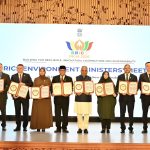
The meeting brought together Union and State ministers and other stakeholders from agriculture and allied sectors.
Ministers from Arunachal Pradesh, Assam, Bihar, Haryana, Jammu and Kashmir, Madhya Pradesh, Nagaland, Punjab, Sikkim, Uttarakhand, Uttar Pradesh and West Bengal participated in the meeting.
The participating ministers expressed satisfaction over the increase in foodgrain production and the broader progress in agriculture and allied sectors. They reaffirmed their commitment to strengthening Centre-State cooperation and working collectively towards farmers’ prosperity.
The meeting began with a presentation on ICAR’s research progress since the previous AGM, covering the Council’s contributions to agricultural research, innovation and development.
The AGM concluded with a reaffirmation of ICAR’s commitment to research, innovation and technology-led agricultural development, with a focus on farmers’ welfare, food and nutritional security and the creation of a resilient, sustainable and self-reliant agricultural sector.
The post ICAR’s 97th AGM charts roadmap for farmer-centric, demand-driven agricultural research appeared first on DD India.