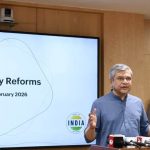
India highlighted major strides in clean energy expansion, hydrocarbons reform and digital mobility infrastructure as global industry leaders converged for India Energy Week (IEW) 2026 in Goa, underscoring the country’s growing influence in shaping the global energy transition.
According to government data, India’s natural gas pipeline network has crossed 25,400 km, enabling near-complete geographical coverage for City Gas Distribution (CGD) projects nationwide. Ethanol blending in petrol has reached 19.05% in the Ethanol Supply Year 2024–25, placing the country close to its national target of 20% by 2025–26. Meanwhile, the Pradhan Mantri Ujjwala Yojana (PMUY) now covers 10.41 crore households, with steadily rising LPG refill rates indicating deeper adoption of clean cooking fuels across the country.
Officials said recent regulatory reforms have strengthened oversight and investor confidence in the hydrocarbons sector. The Oilfield (Regulation and Development) Amendment Act, 2025 and the Petroleum and Natural Gas Rules, 2025 are aimed at simplifying procedures and boosting domestic oil and gas output. Under the Hydrocarbon Exploration Licensing Policy (HELP), 172 blocks covering over 3.78 lakh sq km have been awarded, attracting committed investments of around USD 4.36 billion. In the midstream and downstream segments, the Unified Pipeline Tariff (UPT) system now covers 90% of operational pipelines as of December 2025, reducing regional disparities in gas transportation costs under the “One Nation, One Grid, One Tariff” framework.
The government also underlined major gains in fuel, gas and mobility infrastructure. Fuel retail outlets have risen from 52,000 in 2014 to over one lakh in 2025, while CNG stations have grown from 968 to 8,477 and PNG household connections have increased from 25 lakh to 1.59 crore. Digital payment facilities are now available at more than 90,000 fuel retail points nationwide. Electric mobility infrastructure has also expanded, with over 8,900 EV charging stations installed at fuel outlets under FAME-II, in addition to more than 18,500 charging stations set up by oil marketing companies. The government further reported that more than 500 APNA GHAR trucker facilities and 1,064 integrated energy stations have been established along major travel corridors.
On the clean energy front, the government noted significant progress in biofuels, green hydrogen and renewable energy integration. The ethanol blending programme alone has saved an estimated ₹1.59 lakh crore in foreign exchange and reduced carbon dioxide emissions by 813 lakh metric tonnes since 2014. In the aviation sector, indicative blending targets have been introduced for Sustainable Aviation Fuel (SAF) for international flights beginning 2027. Indian Oil Corporation recently received global certification for SAF production at its Panipat refinery and subsequently signed an MoU with Air India for supply.
India Energy Week 2026, which is underway in Goa from January 27–30, has drawn participation from more than 120 countries and over 6,500 delegates. The platform features strategic and technical discussions covering clean fuels, hydrogen, biofuels, energy security, investment and digital technologies across the global energy value chain. Officials said India’s engagement in international platforms such as the Global Biofuel Alliance (GBA) and the G20 Energy Transitions Working Group reflects its push for inclusive and practical energy transition strategies suited to emerging economies.
With energy demand projected to rise faster in India than in any other major economy through 2035, government officials said New Delhi is poised to play a defining role in global fuel markets and climate transition efforts. The International Energy Agency estimates that India could account for over 23% of global incremental energy demand by 2050.
According to the government, recent gains across hydrocarbons, renewables, biofuels, energy access and infrastructure signal a transition approach driven by “scale, inclusion and implementation,” while balancing rising demand with long-term energy security and climate goals.
The post India Showcases Expanding Role In Global Energy Transition At India Energy Week 2026 appeared first on DD India.