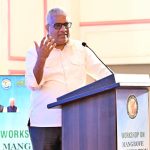
Union Home Minister Amit Shah on Monday said India’s linguistic diversity is its greatest strength and called for strengthening Hindi alongside the preservation and promotion of all Indian languages.
In his message on Hindi Diwas 2026, HM Shah said every Indian language carries a distinct history, folk tradition and worldview, contributing to the cultural identity of the country and helping transmit its values to younger generations.
“Language is not merely a means of communication; it is the memory of a society and its sense of self,” he said, emphasising that India’s linguistic plurality strengthens the spirit of “Unity in Diversity”.
Hindi as a bridge among Indian languages
HM Shah said Hindi has played an important role as a language of dialogue, communication and coordination among people from different sections and communities. He stressed that the development of Hindi can be meaningful only when it progresses alongside the respect, preservation and promotion of other Indian languages.
“Hindi is not a competitor to any language; rather, it is an important link for fostering a sense of affinity and dialogue among Indian languages and strengthening national unity,” he said.
Highlighting India’s history, HM Shah pointed to the contributions of prominent personalities whose mother tongues were not Hindi. Swami Dayanand Saraswati, a native Gujarati speaker, wrote Satyarth Prakash in Hindi. Mahatma Gandhi established the Dakshina Bharat Hindi Prachar Sabha in Madras in 1918, while Netaji Subhas Chandra Bose, a Bengali speaker, adopted Hindi as the language of communication of the Azad Hind Fauj and gave the nation the slogan “Jai Hind”.
HM Shah said the contributions of such personalities demonstrate how people from diverse linguistic backgrounds helped Hindi emerge as a language of communication across the country.
The Home Minister, whose mother tongue is Gujarati, said Hindi has enabled him to connect directly with people whenever he travels across different parts of India.
Hindi’s journey reflects India’s history
Tracing the evolution of Hindi, HM Shah said its journey reflects that of the nation itself, from the Padavali of Vidyapati and the heroic ballads of Prithviraj Raso to the Bhakti period, when Tulsidas took the story of Lord Rama to households across the country and Surdas gave expression to parental affection.
He said the ideals of Swaraj, Swadeshi and Swabhasha played a significant role in creating national consciousness during the freedom movement. Freedom fighters, he added, understood that the vision of Swaraj would remain incomplete without pride in India’s own languages and identity.
After Independence, Indian languages became important instruments of nation-building, governance and development, with Hindi and other languages contributing to social awakening, national unity and the spread of the idea of freedom.
The Constituent Assembly adopted Hindi as the Official Language of the Union of India on September 14, 1949. HM Shah, however, said that despite political independence, the values of Indian languages, culture and self-respect were at times pushed to the margins.
Language central to decolonisation
HM Shah said Prime Minister Narendra Modi’s call from the Red Fort to free India from a colonial mindset has a pivotal connection with language.
He cited the transformation of Rajpath into Kartavya Path as an example of moving away from colonial symbols and said the replacement of colonial-era, punishment-oriented laws with the Bharatiya Nyaya Sanhita, Bharatiya Nagarik Suraksha Sanhita and Bharatiya Sakshya Adhiniyam represented more than a change in terminology.
HM Shah said these changes reflect the restoration of national self-pride.
He also highlighted the role of the National Education Policy in placing the mother tongue at the centre of education. Engineering and medical education is increasingly being offered in Indian languages, while competitive examinations are being conducted in multiple Indian languages.
Technology opening a new era for Indian languages
Referring to the PM Modi’s call on the occasion of the 80th Independence Day for a “Saptadhara of Shakti” for building a Viksit Bharat, HM Shah said the seventh stream – India’s soft power – has a strong connection with language.
He said yoga, Ayurveda, literature, cinema and India’s wider cultural strength reach the world through the country’s languages.
Addressing concerns that technology could marginalise Indian languages, HM Shah said Hindi and other Indian languages are now experiencing a “golden era of technological advancement” under the Modi government.
He highlighted the ‘Bharati’ artificial intelligence-based tool developed by the Department of Official Language to facilitate communication among Indian languages.
The ‘Hindi Shabd Sindhu’, a digital dictionary containing more than 8.27 lakh entries, has emerged as a platform for knowledge sharing, while the Indian Language Section, established in 2024, is facilitating administrative communication in Indian languages.
HM Shah said AI and translation technologies are reducing language barriers and enabling Indians to think in their own languages while communicating with people across the world.
He also noted that during the tenure of the Modi government, the Parliamentary Committee on Official Language has submitted four new volumes of its reports to the President.
HM Shah urges youth to preserve mother tongue
Calling on young people to learn as many global languages as possible without abandoning their own, HM Shah urged parents to communicate with their children in their mother tongue.
He warned against the mindset that speaking one’s own language could make a person appear inferior.
“Language is what connects us with our mother, our soil, our history and our culture,” he said.
HM Shah also recalled that 2026 marks the 150th anniversary of the composition of the national song ‘Vande Mataram’, describing it as an example of how language was transformed into a powerful instrument of the freedom struggle.
He called upon citizens to resolve to make Hindi and all Indian languages powerful instruments in India’s journey towards building a Viksit Bharat by 2047 and extended his greetings on Official Language Day.
The post Hindi and all Indian languages must become instruments of national unity, Viksit Bharat: Amit Shah appeared first on DD India.