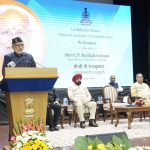
Union Minister of State (Independent Charge) for Science & Technology and Earth Sciences and MoS PMO, Personnel, Public Grievances, Pensions, Atomic Energy and Space, Dr. Jitendra Singh on Wednesday called for a broader, whole-of-society approach to capacity building, stressing that developing the mindset to continuously learn, adapt and innovate is as important as acquiring technical skills.
Addressing a roundtable on capacity building, Singh said the rapid pace of technological and societal change has made continuous learning indispensable. What individuals and institutions learn today could become outdated quickly, he said, underscoring the need to develop the ability to remain lifelong learners.
“Capacity building of the mind”, alongside skills, is essential for India to remain globally relevant, the minister said. He stressed that capacity building should move beyond preparing individuals to perform specific tasks and instead focus on developing mindsets that enable people and institutions to adapt to emerging challenges.
Singh said institutions must work in an integrated manner and coordinate across organisational boundaries to translate policies into effective implementation. India, he added, needs to combine institutional coordination with a wider whole-of-society approach to address rapidly changing technological and global challenges.
The minister also stressed the importance of aligning India’s capacity-building efforts with global benchmarks and strategies. He said the government alone cannot be expected to undertake every task and called for greater participation from the private sector and wider society.
Referring to the opening up of sectors such as space and nuclear energy to private participation, Singh said India needs to develop ecosystems in which government, industry, academia and other stakeholders work together towards common national objectives.
He also called for greater pragmatism in governance, saying officials need to avoid becoming overly constrained by procedural approaches while discharging their responsibilities. Such pragmatism, he said, requires an appropriate change in mindset.
Continuous learning and institutional ecosystem
Highlighting the role of digital platforms in capacity building, Singh said the iGOT platform has more than 40 lakh registered users, providing government officials with opportunities for continuous learning.
He also highlighted the contributions of institutions such as the National Centre for Good Governance and the Indian Institute of Public Administration in strengthening the country’s governance and capacity-building ecosystem.
The minister said various institutions involved in capacity building could be brought together into a larger network. He also highlighted the potential of the Kautilya Centre to connect India’s historical and traditional knowledge with contemporary state capacity and provide a platform for capacity building across the wider Global South.
Push for private participation in research
Singh also emphasised the need for greater participation by non-government stakeholders in research and innovation. Referring to the National Research Foundation (NRF) and the ₹1 lakh crore Research, Development and Innovation (RDI) funding initiative, he said these measures seek to create an environment in which private resources and participation can contribute more significantly to India’s research ecosystem.
He called for a stronger culture of philanthropy for research and innovation, noting that while philanthropic contributions are common in several social and humanitarian areas, research has traditionally received comparatively less attention.
Supporting research aimed at improving human well-being should also be regarded as a form of service to society, Singh said, calling for larger investments from multiple sources to build India’s research and innovation ecosystem.
The minister also highlighted the role of young entrepreneurs in combining talent with entrepreneurship and said that creating an enabling environment for them could accelerate innovation and strengthen capabilities in emerging sectors.
International cooperation
Singh further underlined the importance of international collaboration for capacity building and knowledge exchange. He pointed to growing engagement among countries of the Global South and said such cooperation could create broader networks for sharing knowledge, experience and best practices.
He concluded by stressing that capacity building should enable individuals, institutions, government, industry and society to contribute effectively to India’s development and strengthen the country’s ability to remain globally relevant.
The post Capacity building of mind, alongside skills, essential for India to remain globally relevant: Jitendra Singh appeared first on DD India.